
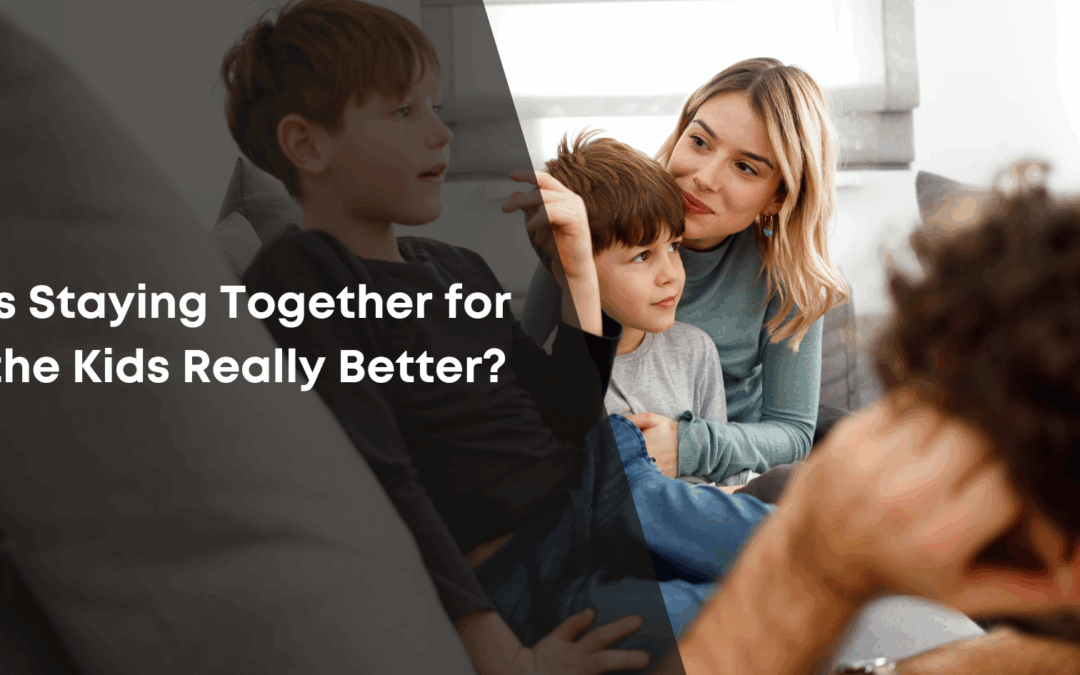
What If the “Right Thing” Is Hurting Everyone?
You love your kids more than anything. You’d do anything to protect them. That’s why, even though your marriage feels broken, you keep telling yourself: “We have to stay together—for the kids.”
It sounds noble. Selfless, even. But what if that choice—staying in an unhealthy marriage—isn’t protecting your children at all? What if it’s actually hurting them?
That’s the story gap: You’re doing what you think is best. But deep down, you’re wondering if it might be doing more harm than good.
When Good Intentions Hide Real Damage
Let’s break down the problem. Because it’s not just about staying or leaving—it’s about what your kids are experiencing right now.
When good intentions hide real damage, it’s easy to overlook what your children are actually experiencing. A home filled with tension, silence, and unresolved conflict creates emotional stress—even when parents try to hide it. Studies from the American Psychological Association show that ongoing parental conflict can be more harmful to children than divorce itself. Yet you feel stuck—carrying guilt, fear, and the pressure to hold it all together for the sake of your kids. You worry about being seen as the “bad parent” if you leave, even as the weight of staying grows heavier by the day. But is it fair to raise children in a home where love is gone and emotional safety is missing? Staying together at any cost teaches kids that dysfunction is normal—and that’s not the legacy you want to leave. The good news is: it doesn’t have to stay this way.
There’s a Different Path—One That Honors Your Kids and Your Wellbeing
I’m Steven Unruh, and I’ve spent over 30 years as a divorce mediator helping couples navigate one of the hardest decisions of their lives—with dignity, compassion, and clarity.
I care deeply about families. And I’m here to tell you: it is possible to separate in a way that preserves stability, creates emotional health, and protects what matters most—your children’s future.
Let’s explore how.
1. Pay Attention to What Your Kids Are Actually Experiencing
It’s easy to assume that staying under one roof is best for your children—but what are they really experiencing day to day? Kids may not understand every adult conversation, but they feel the tension. They notice the silence at dinner, the lack of affection, the stress in the air. They often internalize that stress, blaming themselves or feeling like they have to tiptoe around conflict. Just because a family looks “intact” from the outside doesn’t mean it feels safe on the inside. If your home no longer feels like a place of warmth, peace, and emotional support, your children are already affected. Staying together only benefits kids when the environment is healthy—and when it’s not, they carry the weight of that long after childhood ends.
2. Redefine What Stability Really Means
Many parents equate “staying married” with “providing stability.” But real stability isn’t about sharing a roof—it’s about emotional safety, consistent love, and healthy communication.
Divorce—when handled respectfully—can actually increase stability. Kids no longer have to walk on eggshells. They can experience peace in two loving homes rather than stress in one fractured one.
Mediation allows you to create a structure for this new kind of stability—one that prioritizes your children’s needs and routines.
3. Choose Peace Over Prolonged Pain
You don’t have to blow everything up. Divorce mediation is a powerful alternative to courtroom battles. It helps you:
Resolve disputes privately and respectfully
Create a customized parenting plan
Reduce legal costs and emotional strain
Protect your kids from conflict
Instead of fighting over who’s “right,” mediation helps both of you focus on what’s best—especially for your children.
4. Model Healthy Conflict Resolution
Your children are watching you. Every day. And how you handle this transition teaches them volumes about relationships, boundaries, and emotional health.
When you model mature, respectful conflict resolution—especially through mediation—you give your children a gift: the ability to advocate for themselves, to choose peace over chaos, and to believe that they deserve relationships built on trust and respect.
That’s a legacy worth leaving.
5. Give Yourself (and Your Kids) a Chance to Heal
When you stay in a painful marriage, there’s little room for growth. But when you create space—emotionally and physically—you give everyone in the family the chance to heal, reset, and rediscover what happiness can look like.
Kids are resilient. But they thrive best when their parents are emotionally well. Don’t underestimate the power of giving yourself permission to heal—it’s one of the most loving things you can do for them.
But Isn’t Divorce Selfish?
That’s one of the most common fears I hear. And I understand it.
But let’s reframe it.
Is it selfish to remove your children from a toxic environment?
Is it selfish to prioritize emotional safety over appearances?
Is it selfish to want your kids to grow up watching their parents treat each other with kindness, even from separate homes?
Divorce isn’t always the selfish choice. Sometimes, it’s the bravest one.
Ready to Create a Healthier Future?
You don’t have to stay stuck in pain to prove you’re a good parent. There is a better way forward—and you don’t have to navigate it alone.
If you’re ready to talk about whether divorce mediation could be the path for your family, I invite you to reach out.
Together, we can:
Create a respectful, child-focused plan
Lower conflict and legal costs
Preserve what’s best about your family, even in a new structure
You deserve peace. Your children deserve security. And the future doesn’t have to be a battlefield.
Let’s take the first step—schedule a free consultation today.
Recent Comments